
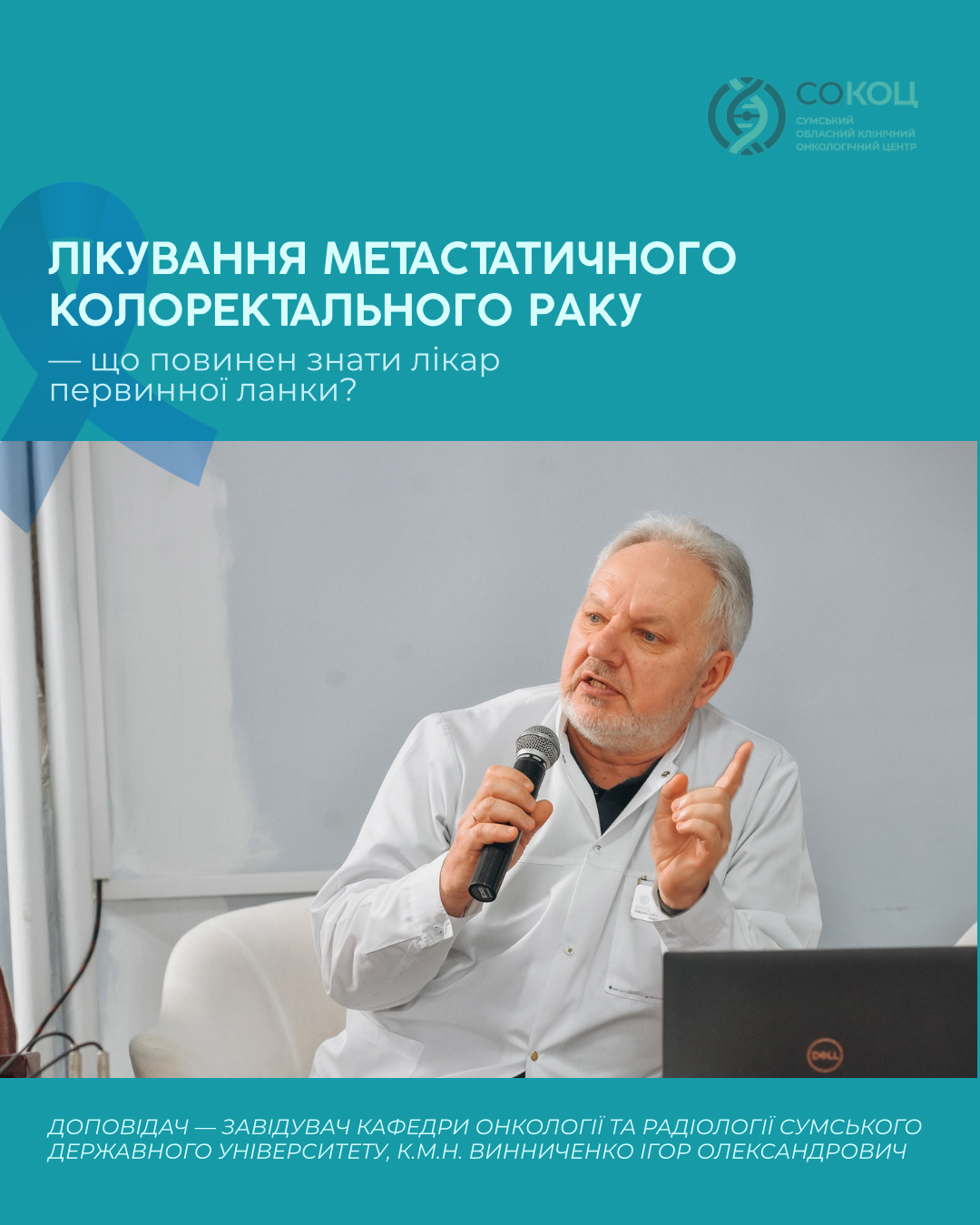
On 20 May, at one of the training seminars for family doctors organized by the Sumy Regional Clinical Oncology Center, a presentation was given on the topic:
“Modern treatment of metastatic colorectal cancer with liver and lung metastases: what should a primary care doctor know?”
The presentation emphasized that metastatic colorectal cancer today is not always a “hopeless diagnosis.” Colorectal cancer is one of the most common cancers in the world. The liver is the main site of metastasis, and the lungs are the second most commonly affected. Up to 50% of patients develop liver metastases during their lifetime, but some of these patients are potentially curable.
The main changes in the approach to treatment over the past 15 years were discussed separately: the shift from a palliative model to the concept of long-term control and potential cure. The modern strategy includes systemic therapy, molecular personalization, liver and lung surgery, local treatment methods and the work of a multidisciplinary team (MDT).
The presentation highlighted the modern principle: “Unresectable today does not mean unresectable tomorrow.”
The symptoms that should raise a family doctor’s suspicion were also presented. Symptoms of primary colorectal cancer include:
Illustration: Training seminar for family doctors anemia, Illustration: Training seminar for family doctors blood in the stool, Illustration: Training seminar for family doctors changes in bowel habits, Illustration: Training seminar for family doctors weight loss, Illustration: Training seminar for family doctors abdominal pain, Illustration: Training seminar for family doctors weakness.
Special attention was paid to the symptoms of liver metastases:
Illustration: Training seminar for family doctors hepatomegaly, Illustration: Training seminar for family doctors pain or heaviness in the right upper abdomen under the ribs, Illustration: Training seminar for family doctors elevated liver enzymes, Illustration: Training seminar for family doctors weight loss, Illustration: Training seminar for family doctors jaundice in later stages.
The importance of correct patient routing was emphasized:
family doctor → colonoscopy → CT → oncology center → MDT.
One of the typical mistakes in primary care is to regard liver metastases as a “terminal condition” without consulting a specialized center.
The presentation reviewed modern methods for diagnosing liver metastases:
- contrast-enhanced CT,
- contrast-enhanced liver MRI, PET-CT,
- intraoperative ultrasound.
It was emphasized that MRI is increasingly becoming the “gold standard” for assessing small metastases.
A separate section was devoted to the role of molecular diagnostics. Mandatory markers include: KRAS, NRAS, BRAF, MSI/MMR, and HER2 in some patients.
It was emphasized that mutations determine the prognosis, the choice of targeted therapy, the effectiveness of anti-EGFR drugs and whether immunotherapy can be used.
The presentation also introduced the concept of the MDT (multidisciplinary team), which includes a surgical oncologist, a clinical oncologist, a hepatobiliary surgeon, a radiation oncologist, a pathologist and a diagnostic radiologist.
Special attention was paid to current trends in liver surgery. Today, what matters is not the number of metastases but whether all lesions can be removed while preserving a sufficient volume of functioning liver.
Modern technologies were presented: 3D planning, intraoperative ultrasound, navigation surgery and RVS (fusion imaging).
The capabilities of FUJIFILM Synapse 3D, intraoperative ultrasound navigation (IOUS), Real-Time Virtual Sonography and PACS were also demonstrated. PACS is a digital system for storing, transmitting and viewing medical images that makes it possible to hold MDT discussions and integrate with 3D planning.
The section on systemic therapy presented the main chemotherapy regimens:
Illustration: Training seminar for family doctors FOLFOX, Illustration: Training seminar for family doctors FOLFIRI, Illustration: Training seminar for family doctors FOLFOXIRI in combination with:
Illustration: Training seminar for family doctors bevacizumab, Illustration: Training seminar for family doctors cetuximab, Illustration: Training seminar for family doctors panitumumab.
The concept of conversion therapy, which aims to make the patient’s disease operable, was discussed separately.
Considerable attention was paid to immunotherapy. MSI-high/dMMR tumors can respond dramatically well to treatment with pembrolizumab, nivolumab and ipilimumab.
The presentation emphasized:
“Immunotherapy does not attack the tumor directly — it ‘unlocks’ the patient’s own immune system.”
Local methods for controlling liver metastases were also presented: RFA (radiofrequency ablation), microwave ablation, SBRT and TACE.
The final part of the presentation covered factors associated with a better prognosis: R0 resection, response to chemotherapy, limited liver disease, absence of a BRAF mutation and good ECOG performance status.
It was emphasized that today the 5-year survival rate after resection can exceed 50%.
The role of the family doctor during treatment was also presented: monitoring CEA, CT scans, monitoring toxicity, nutritional support and psychological support.
The conclusions of the presentation emphasized:
Illustration: Training seminar for family doctors Metastatic colorectal cancer (CRC) is increasingly a controllable disease;
Illustration: Training seminar for family doctors Some patients are potentially curable;
Illustration: Training seminar for family doctors The MDT is the central element of treatment;
Illustration: Training seminar for family doctors Early routing is critically important;
Illustration: Training seminar for family doctors The family doctor is the first key participant in successful treatment.