
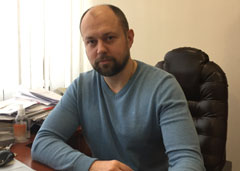
 Ahead of World Cancer Day, observed on 4 February, VSh visited the Sumy Regional Clinical Oncology Center, the only specialized medical facility providing this care to residents of our region.
Today, about 37,000 people in Sumy Region have been diagnosed with cancer. Each year, about 4,000 cases of malignant neoplasms are registered for the first time, and 2,000 patients die of the disease. How is the facility coping during the pandemic? Has the situation with medicines and renovations improved? We talked about this with Director Volodymyr Shevchenko.
In a year or two there will be more patients with advanced disease
According to the director, cancer remains as pressing and widespread a problem as before. Unfortunately, the coronavirus has changed things: patient visits to the Oncology Center have dropped by almost 40%. This applies to both outpatient and inpatient care.
“Since last summer, when a new outpatient department opened at 48 Troitska St, conditions for outpatient appointments have improved significantly,” says Volodymyr Shevchenko. “That is where our specialists see patients and where our diagnostic service is. But because of the pandemic, many people simply do not come to us. Unfortunately, this means more cancers will be diagnosed at a late stage, and in a year or two there will be more patients. Today we see a decrease in incidence, but not because people in the region have started getting sick less often: the statistics simply do not see them yet. In addition, COVID weakens the body's immune response, which in turn increases the risk of cancer. I want to point out that we are working at full capacity. Outpatient appointments run as usual, and hospitalization requires a negative PCR or ELISA test for COVID-19.”
<iframe width=”512″ height=”384″ src=”https://www.youtube.com/embed/raHciJoNAno” frameborder=”0″ allow=”accelerometer; autoplay; clipboard-write; encrypted-media; gyroscope; picture-in-picture” allowfullscreen></iframe>
To see specialists at the outpatient clinic, the director explained, you need a referral from your family doctor, but you can also make an appointment on your own. Registration desk phone numbers: (0542) 700-351, 700-352. You can also do this through the Helsi app or on the Oncology Center's website (onko.sumy.ua).
“Our outpatient clinic now offers laser surgery: operations on the skin and mucous membranes are performed on an outpatient basis,” Volodymyr Shevchenko continues. “Under the Program of Medical Guarantees, a number of diagnostic examinations are free of charge: bronchoscopy, colonoscopy (bowel), gastroscopy (stomach, esophagus), hysteroresectoscopy (female reproductive organs) and mammography. The outpatient clinic has all the necessary modern equipment and two ultrasound rooms. Only the mammography machine is located at the inpatient unit. Endoscopic examinations, such as colonoscopy or gastroscopy, are now performed under general anesthesia, which was not the case before. For the patient, the procedure is free of pain and discomfort. So if you have a health problem, do not put off seeing a doctor. If a patient cannot get to a family doctor, our specialists will examine them free of charge even without an e-referral from their family doctor or attending physician. If necessary, they will order the examinations used for early detection of cancer.”
Medicines: better, but not for chemotherapy
The Oncology Center has 330 inpatient beds. About 10,000 patients receive care here each year; more than 3,000 receive chemotherapy and 3,500 receive radiation therapy.
“We admit everyone who needs inpatient treatment,” the director says. “A negative COVID test is mandatory. Unfortunately, we lack many of the medicines (supplied under the state program) needed for specialized treatment, which includes chemotherapy. State supplies arrived only in 2019; in 2020 we received nothing at all. This year we bought UAH 1.3 million worth of medicines for our patients ourselves. But that is not much. We cannot purchase expensive modern medicines (for example, at UAH 120,000 each for immunotherapy) that are not included in the National List of Essential Medicines. So, unfortunately, patients buy some of the chemotherapy drugs themselves.”
But the supply situation has improved: with funds from the National Health Service of Ukraine (NHSU), we carry out examinations and purchase the medical supplies and medicines needed to treat patients. Today the financial burden on patients treated in the inpatient unit is much lower. We have almost everything, with a few exceptions. Sometimes medicines are not available on the market. Hospitals now buy medicines themselves through tenders, and because of high demand suppliers may run out of them. Then there are interruptions. Or a patient may need a more effective medicine or material. Recently I operated on a patient, and the Oncology Center provided everything. The only thing she bought herself was a special cosmetic suture. But soon we will be buying such sutures ourselves too. Over time we will get the balance right, as we had no experience with such purchases before. We hope that funding will improve from April, when we sign new contracts with the NHSU.
The main renovation issue, and more
For more than 10 years, the chemotherapy department has been housed in the radiation therapy building, where conditions for patients leave much to be desired. The two-story building where the department used to be was closed because it was unsafe.
“Of course, patients need a proper department to be comfortable,” Volodymyr Shevchenko is convinced. “We will set aside NHSU funds to start renovation work. The regional leadership supports us in getting the major renovation (reconstruction) project included in this year's funding program of the State Fund for Regional Development (SFRD). One option under consideration is a 40-bed chemotherapy department in the space freed up by the outpatient clinic (the right wing of the main five-story building). We have already prepared the design and cost estimate documentation; the work will cost up to UAH 6 million.
“In fact, we have many plans: every department needs renovation, and we want to improve the courtyard and grounds and create a small park where people can rest. Everything has to be put in order to improve conditions for our patients.”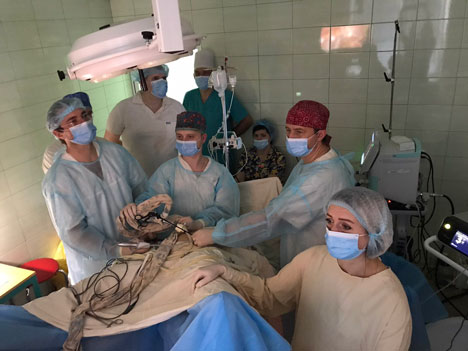
There is already progress: since last fall, with funds from the SFRD and the regional budget, the main building has been undergoing energy-efficiency upgrades (structural strengthening of the building, wall insulation, facade finishing, installation of a roof drainage system, a new basement entrance, replacement of windows and doors, etc.). The tender was won by the Sumy company “Spetstekhbud” (with a bid of UAH 7.54 million). Half of the planned work has already been completed. According to the director, the building that houses the gynecology department, two surgical departments and the thoracic inpatient department has become warmer. The building is expected to be handed over in May.
New opportunities for laparoscopic surgery
The Oncology Center is introducing innovative treatment methods. In surgery, the specialists have set a course for laparoscopic operations.
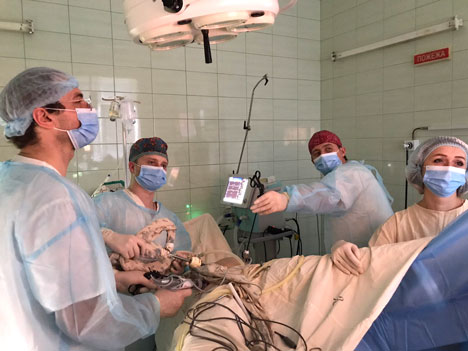
“A few days ago we performed another laparoscopic rectal resection,” says the director of the Oncology Center. “Previously, with open abdominal surgery through an incision, the patient stayed in the hospital for about two weeks; now they are discharged on day 5–6. After laparoscopic surgery, the patient is back on their feet the very next day. We perform 60% of our gynecologic cancer operations laparoscopically. Our specialists hold master classes across Ukraine. Now we are introducing laparoscopy for abdominal surgery. Specialists from the National Cancer Institute of Ukraine come to us, and we perform these operations together. We have mastered sigmoid colon resection. Overall, we are moving actively in this direction. Previously, patients traveled outside the region, to Kyiv or Kharkiv, for laparoscopic surgery; now we are developing it in Sumy.”
Our plans include buying another modern Karl Storz laparoscopic tower. This will expand what laparoscopic surgery can do: staining areas with special markers to visualize the tumor and working in 3D. Incidentally, we performed a gynecologic cancer operation on a 3D tower for the first time; it was provided to us for trial use, and the operation was broadcast from the operating room on a closed channel for specialists across Ukraine. We need such a tower. Patients want modern surgery and comfortable conditions. We will keep working hard on this.
What about the linear accelerator?
The purchase of a linear accelerator for radiation therapy has been discussed for several years now. The project is expensive. In 2019, almost UAH 1.5 million was allocated from the regional budget for design and cost estimate documentation for the reconstruction of the Oncology Center (it is now 40% complete). The plan was to build a special three-story facility for a linear accelerator, which the region intended to buy with SFRD funds. The estimated cost of the project was UAH 120 million. A separate permanent building with offices for specialists, a bunker for the linear accelerator and a room for a CT scanner was to be built on the grounds of the Oncology Center. Toward the end of 2020, a new option emerged for providing the facility with a linear accelerator while saving on both the machine and construction. For this purpose, they considered the possibility of
using the room at the Oncology Center that houses the non-functioning “Rokus-AM” gamma therapy unit for the linear accelerator. Once that unit is dismantled, a modern low-energy linear accelerator could be installed in this bunker; it covers 95% of the capabilities of a high-energy one (which was originally planned for purchase). The room's area, wall thickness and ceiling make this possible. This would have cut costs by UAH 30 million. But so far, neither of these options has gotten off the ground.
“This year a new working group has been set up to study the options, namely which accelerator the region needs,” Volodymyr Shevchenko explained. “For now all options are still open, and we have to choose the best one. Everyone understands that a linear accelerator is necessary.”